
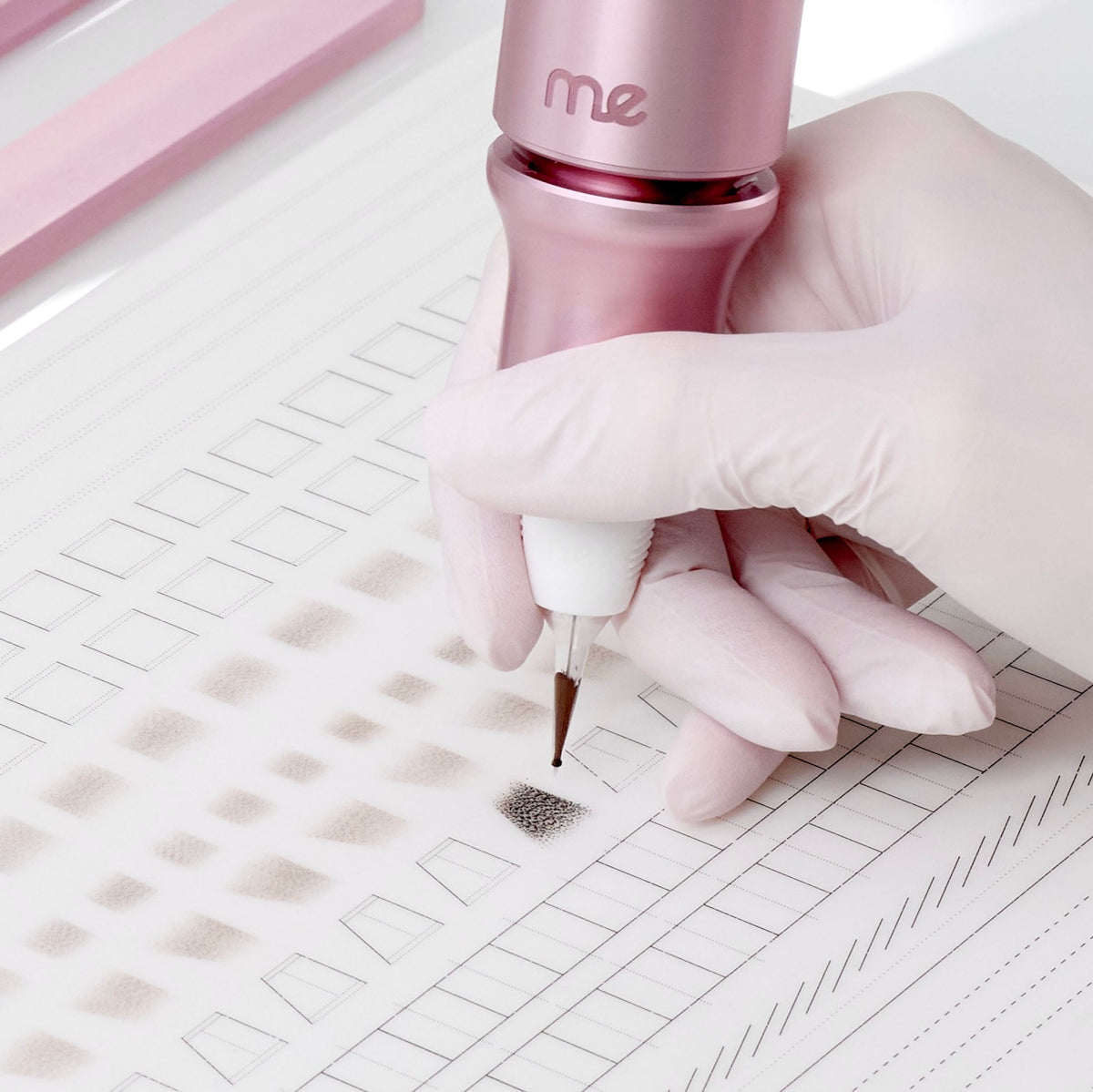
The movement looks smooth. Your hand travels rhythmically from side to side, the machine runs at a steady 60 Hz, yet the practice skin shows dark dots at the ends, a heavy centre or stripes instead of a soft, diffused effect.
The most common advice is to “keep an even pace”. That is sound advice, but it is incomplete. A gradient does not come from the shape of the pendulum movement alone. It comes from the distribution of effective needle contacts along the path. That distribution depends on hand speed, machine frequency, how the needle enters and leaves the surface, the amplitude of the movement and the overlap between successive paths.
This is why two pendulum movements that look similar from above can leave completely different marks. The path tells you where the hand travels. It does not yet tell you how quickly it moves through each section or during which part of the movement the needle actually contacts the tissue.
What is a pendulum movement in PMU?
In PMU training, a pendulum movement means repeatedly moving the tip between two sides of the treatment area. It may follow a short arc, a straight segment or a flattened ellipse. Different training schools use the same term for movements with slightly different amplitudes, hand support and points at which the needle leaves the surface.
It is therefore not a single standardised trajectory. A technical description of the movement needs to specify at least:
- path — the route followed by the tip;
- amplitude — the width of the movement;
- period — the time taken to travel there and back;
- speed profile — where the hand accelerates and slows down;
- contact window — the part of the path during which the needle actually interacts with the surface;
- offset between successive pendulum movements — how neighbouring paths overlap.
Mechanics and robotics make a similar distinction: a path describes the geometry, while a trajectory adds information about timing and the speed at which that path is followed.
The machine produces cycles over time; the hand distributes them across space
If a machine is actually running at 60 Hz, it completes 60 full cycles every second. It does not know whether your hand is moving quickly, slowly, along an arc or staying in one place.
In a simple model, the potential spacing between cycles along the path can be expressed as:
cycle spacing = hand speed ÷ frequency
At 60 Hz and a hand speed of 30 mm/s, successive cycles theoretically occur every 0.5 mm. When the hand slows to 12 mm/s, that distance falls to 0.2 mm.
This does not mean that every cycle leaves a dot. Some needle movements may take place above the surface, some may only deform it, and some may transfer pigment effectively. The equation describes the rhythm of the mechanism relative to the distance travelled, not the resulting pigment deposit.
It does, however, show a basic principle: if frequency stays constant, a slower hand increases the number of potential contacts along the same length of the path.
What happens at the turning point?
To change direction from right to left, the hand has to slow its movement in one direction and begin moving in the other. Its speed along the path falls to zero at the turning point, even if the pause lasts only a fraction of a second.
If the tip remains in contact with the surface at that moment, the machine continues cycling. Several consecutive cycles may therefore be concentrated within a very small area. A darker dot, a comma-shaped mark or an end that looks heavier than the rest of the movement appears on the practice skin.
This is not an unavoidable flaw of pendulum shading. The artist can limit the concentration of contacts by ending the contact window before the hand comes to a complete stop, smoothly changing the orientation of the movement or deliberately placing the turning point outside the area being worked.
The key distinction is:
- the hand’s turning point occurs whenever it reverses direction;
- a turning point in contact with tissue occurs only if the needle stays at the surface during that change.
An overhead camera shows the first. A side view is needed to assess the second.
Why can the centre of a pendulum movement be darkest?
In the classical model of oscillation, speed is highest in the middle of the path and lowest at the ends. Lateral speed alone would therefore suggest a lower concentration of contacts in the centre, not a higher one.
PMU adds another dimension: the distance between the tip and the surface. If the hand guides the cartridge along an arc, the needle may:
- make contact as it approaches the centre;
- reach its most stable contact in the central section;
- gradually leave the surface as it travels out towards the other side.
The centre then receives more effective contacts because this is where the needle’s main working window occurs, rather than because the hand is moving more slowly there.
This explains the apparent contradiction. Dark ends may result from slowing down while maintaining contact. A dark centre may result from the entry and exit profile. The relationship between these two effects produces the final gradient.
Analyse lateral movement and axial contact separately
The tip undergoes two movements at the same time:
- the needle’s movement along the cartridge axis, produced by the machine;
- the movement of the entire machine across the area, produced by the artist’s hand.
The machine controls the first. The artist controls the second, along with the position of the axis relative to the surface. A steady 60 Hz will not ensure an even gradient if the hand stops at the ends or changes height unintentionally. Equally, a perfectly repeatable hand movement will not compensate for a machine whose frequency changes under load or whose cartridge actuation is irregular.
This is why “a slower machine” and “a slower hand” are not interchangeable. Reducing Hz decreases the number of cycles over time. Slowing the hand increases the time spent over a particular section. Either change may make individual dots more or less distinct, depending on the contact window.
Amplitude changes more than the width of the shading
Suppose two pendulum movements have the same rhythm: each full back-and-forth cycle takes half a second. The first is 4 mm wide and the second is 10 mm wide.
In the longer movement, the hand has to cover a greater distance in the same time, so its average speed is higher. At the same frequency, cycles will be spaced further apart. If the artist does not change the contact window, the longer pendulum movement may leave a more dispersed mark.
This does not mean that a large amplitude always produces a light gradient. The artist may slow the rhythm, increase the overlap between neighbouring pendulum movements or maintain contact through a larger part of the arc. The overall density will then increase again.
This is why a trainer should specify both the length of the movement and the time taken to complete it. “Make a longer pendulum movement” does not define speed unless the rhythm is also specified.
What causes an asymmetrical gradient?
If one side of every pendulum movement is darker, the problem is not necessarily the pigment or cartridge. Common mechanical causes include:
- faster acceleration in one direction and a slower return;
- maintaining contact to the end in one direction but breaking it earlier in the other;
- changing the machine angle as the forearm pronates or supinates;
- supporting the hand more firmly on one side of the area;
- varying the distance by which the next path is offset;
- pausing when changing the grip or wrist orientation.
Flow may also be involved: the first part of the movement after loading pigment may leave a more distinct mark than the next. If the asymmetry consistently follows the direction of travel, check the technique. If it changes with the amount of pigment in the tip, check the pigment flow path.
Troubleshooting pendulum shading
| Observation | Possible mechanism | What to check first |
|---|---|---|
| A dark dot at both ends | Contact maintained during deceleration and the change of direction | A side view and the moment the tip leaves the surface |
| A dark centre with soft edges | The longest or most stable contact window is in the centre | Whether the effect is intentional and repeatable across successive sets |
| One side is always darker | Asymmetrical pace, angle, support or exit timing | A recording of movement in both directions using the same setup |
| Stripes between pendulum movements | Uneven spacing or insufficient overlap between neighbouring paths | A guide grid and the offset after each hand cycle |
| The whole area becomes heavy | Slow movement, extensive overlap, a long contact window or repeated layers | The pattern of passes and the purpose of the next set |
| The pendulum movement is even, but pixels fade | Irregular flow, ineffective contact or reduced performance under load | The cartridge, needle protrusion, pigment and drive behaviour |
The table does not assign a single cause based on appearance. It helps you decide what to test first.
How can you practise pendulum shading to see the cause as well as the result?
1. Start without the machine
Draw several parallel lines of equal length. Move a pen back and forth and observe whether pressure increases at the turning points. Paper does not reproduce pigment implantation, but it immediately reveals pauses and asymmetry in your hand movement.
2. Mark the amplitude
Mark two points a specified distance apart on the practice skin. Do not judge a “short” or “long” movement by eye. Repeat a set at one frequency, taking a similar time to complete each movement.
3. Record both directions
Position your phone above the area, then record from the side. The overhead view shows the path and width. The side view shows entry, exit and whether the tip stays at the surface while the hand reverses direction.
4. Change one variable at a time
First compare two paces at the same amplitude. Then compare two amplitudes at the same rhythm. Only then change Hz. Adjusting everything at once will not show you what improved the gradient.
5. Assess each set after wiping
Pigment sitting on the surface can conceal dark dots and stripes. Compare spacing, the shape of the ends, symmetry between directions and the number of repetitions needed to produce a comparable area.
6. Do not treat practice results as a 1:1 match for living tissue
Practice skin does not swell and usually deflects differently. On living tissue, reassess stabilisation, the local angle, the tissue response and whether the gradient remains clear after wiping. A mechanical test is a starting point, not evidence of safety.
Is there an ideal frequency for pendulum shading?
No. A single value does not define density unless we also know the hand pace, amplitude, contact window, cartridge and tissue behaviour.
Higher Hz can produce more potential cycles along the same path. If the artist also moves the hand faster, spacing may remain similar. Lower Hz will not guarantee a lighter result if the movement slows, overlap increases or the pendulum movement is repeated many times.
A predictable machine has a different job: to deliver the selected cycles as consistently as possible, including under load. It does not create the path for the artist, but it provides a more consistent reference when calibrating technique.
What is established fact, and what is an inference for PMU?
It is a fact that the geometry of a path does not describe the speed at which it is followed. When the hand reverses direction, its speed along the path briefly falls to zero, while a machine running at a constant Hz continues cycling. It is also a fact that frequency and hand speed together determine the theoretical spacing of cycles across the surface.
The engineering inference for PMU is that the gradient depends on which cycles become effective contacts. A dark end can result from staying at the surface during the turn, while a dark centre can result from a longer or more stable contact window in the middle of the movement.
No controlled clinical studies were identified comparing specific amplitudes and pendulum movement profiles in eyebrow or lip PMU. There is therefore no basis for publishing a single pendulum length, pace or Hz setting that guarantees a soft gradient and a particular healed outcome.
FAQ
Why does a dark dot form at the end of a pendulum movement?
The hand slows before reversing direction. If the needle stays at the surface, several cycles may be concentrated within a small area. Check when contact ends instead of automatically reducing Hz.
Should the centre of a pendulum movement be darkest?
It can be, if the technique is intended to maintain the longest or most stable contact in the middle of the arc. This does not automatically follow from the shape of the movement, however. The gradient should be intentional and repeatable.
How does pendulum shading differ from whip shading?
Terminology varies between training schools. The most useful distinction is the direction of contact: in a pendulum movement, contact may occur in both directions, whereas in whip shading the main pigment implantation often occurs in one direction, with the return used to position the next movement.
Does a faster hand always produce a lighter gradient?
Not always. It may increase the spacing between potential contacts, but the result also depends on Hz, amplitude, overlap, contact depth and the number of layers. A fast movement repeated many times can produce a heavy area.
Does a metronome help when practising pendulum shading?
It helps maintain the duration of the hand cycle, but it does not control amplitude or contact timing. Two movements performed to the same rhythm may have different speeds if their lengths differ.
Should you reduce Hz if the ends are dark?
That is not the first step. First check whether the hand pauses and whether the tip stays in contact during the turn. Reducing Hz may conceal part of the symptom, but it will not correct an asymmetrical trajectory.
Will a better machine improve pendulum shading?
It will not make the movement for the artist. A stable drive can, however, reduce variation in the number and character of cycles under load, making it easier to assess and repeat your technique.
Conclusions
A pendulum movement is not a single line drawn by the machine. It combines needle movement along the machine axis with the trajectory of the hand above the surface. Path shape, pace, amplitude and the contact window together determine where cycles are spread out and where they become concentrated.
If the gradient is uneven, do not begin by changing Hz at random. First check the turning points, symmetry between directions, entry and exit timing, and overlap between neighbouring paths. Only then adjust the machine setting.
Engineering before marketing means a simple principle here: a movement that looks smooth does not necessarily have a smooth profile. Assess the distribution of effective contacts it leaves behind, as well as the arc of the hand.
Hand movement creates the gradient, but it needs a predictable reference. Explore ME™ machines and compare Motion Control™ profiles using the same amplitude, frequency and cartridge, assessing the distribution of dots as well as how the machine feels.

Leave a comment
All comments are moderated before being published.
This site is protected by hCaptcha and the hCaptcha Privacy Policy and Terms of Service apply.